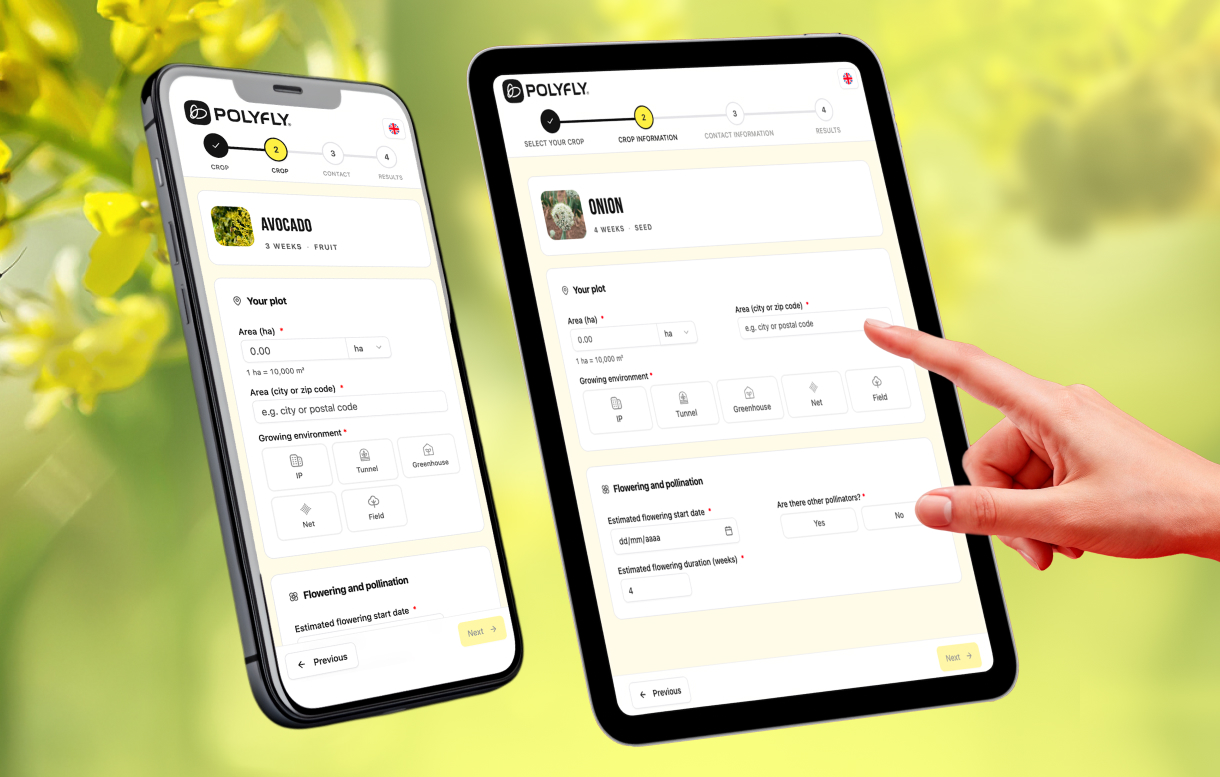
How Polyfly’s calculator works: the first step toward precision pollination


Every crop is unique: the plant type, the environmental conditions and the characteristics of flowering determine how many pollinators you need and how releases should be planned.
In nature, no two blooms are identical. The plant type, the microclimate of the greenhouse or plot, and the anatomical particularities of each flower shape how pollination will go. That is why determining how many hoverflies a farm needs requires proper planning.
To help you, at Polyfly we have developed our Pollination Calculator, a tool accessible both on our main website and on each crop’s data sheet, designed to calculate the estimated density of hoverflies required by each production.
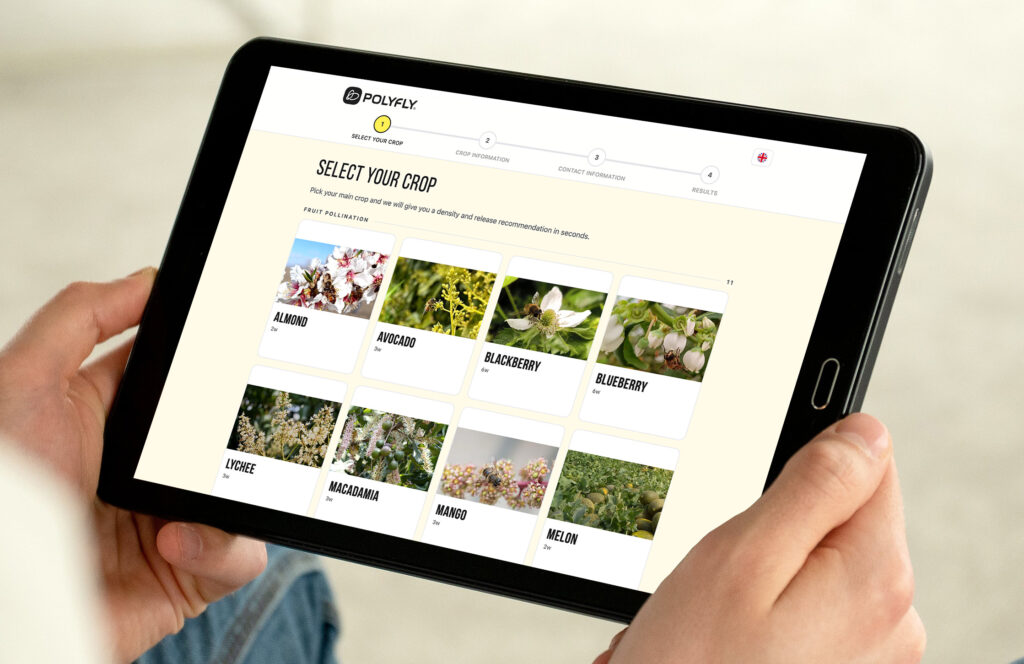
This platform draws on years of field research across a wide range of commercial crops and seed production, in greenhouses, tunnels, shade nets and open field. Among them are fruit and subtropical crops (avocado, mango, almond, cherry), soft fruits (strawberry, blueberry, raspberry, blackberry), vegetables (melon, watermelon) and seed production (onion, rapeseed, carrot, leek, celery, chicory, brassicas), among others. This is what allows the estimate to be adjusted to the real environment of each farm.
Insect density is only one part of planning. An effective pollination strategy requires coordinating the release schedule with the crop’s phenology. At Polyfly we recommend making the first release just as flowering begins, so that emerging adults have nectar and pollen right away to start their work.
From there, we advise at least two releases: the first at the start of flowering and a second one week later or every 15 days, so that insect activity coincides with the flowering peak. The frequency of later applications will be adapted according to the duration of flowering and weather conditions, among other factors.
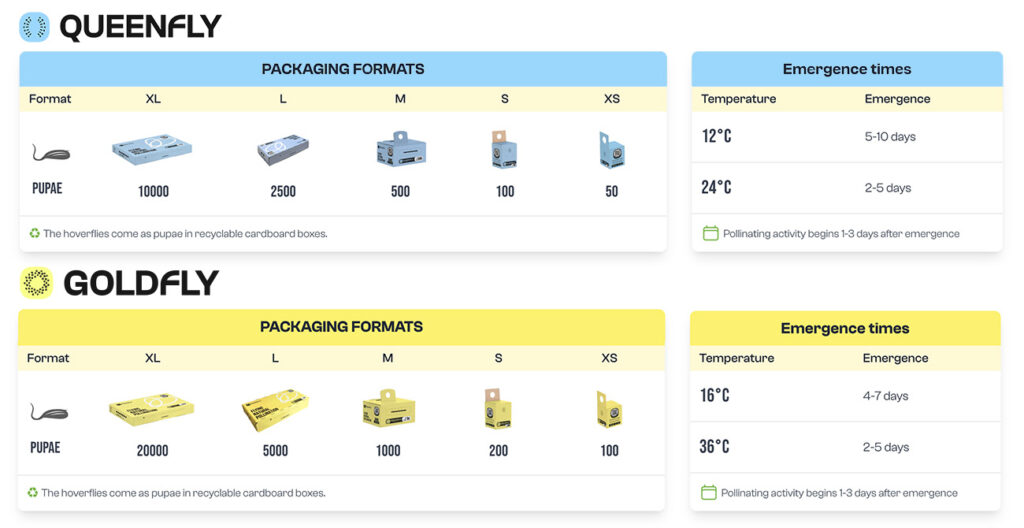
Our species QUEENFLY® (Eristalis tenax) and GOLDFLY® (Eristalinus aeneus) offer different adaptation ranges depending on the production system and local temperatures. QUEENFLY is the ideal choice for cool climates, with an optimal range of 10–30 °C, such as winter or early spring. GOLDFLY performs best in warm conditions, between 16 and 36 °C, making it the perfect choice for spring and summer.
Both species work well in greenhouses, tunnels, shade nets or open field. They remain active even at extreme temperatures, in wind or under overcast skies, and are fully compatible with bees and bumblebees: their different flight behaviors complement each other and promote more uniform fruit set of higher quality.
Formats tailored to each farm
Once the density has been calculated, the grower can adjust the order to the real needs of their plot thanks to our five formats of recycled, ready-to-use boxes (XS, S, M, L and XL), ranging from 50 to 20,000 pupae.
The boxes feature release windows on both sides to facilitate uniform emergence of adults and good internal ventilation. A few days after placing the boxes you should see adult hoverflies actively visiting flowers, especially during the central hours of the day. The definitive proof will come with good fruit set and an improvement in the quality and yield of the harvest.
Pollination strategy adapted to your needs
The calculator provides the ideal technical starting point, and our technical team analyzes the environment, phenological stage, time of year and environmental conditions of your farm to recommend the most suitable species, number of releases and optimal timing of application.
Calculate the estimated density for your crop now in our Pollination Calculator and contact us to design your pollination strategy together.