Polyfly hoverflies, a new step in the history of natural pollination



The history of agriculture is closely linked to that of pollinators. For thousands of years, honey bees (Apis mellifera) and other insects that provide ecosystem services have been essential allies of humankind. Initially, their activity was entirely wild. Later, it led to the development of organized beekeeping, already documented in Ancient Egypt. For centuries, in addition to harvesting the prized honey, their role was decisive in the agricultural production of fruits, seeds, and vegetables. As a result, they became established as the main reference for agricultural pollination worldwide.
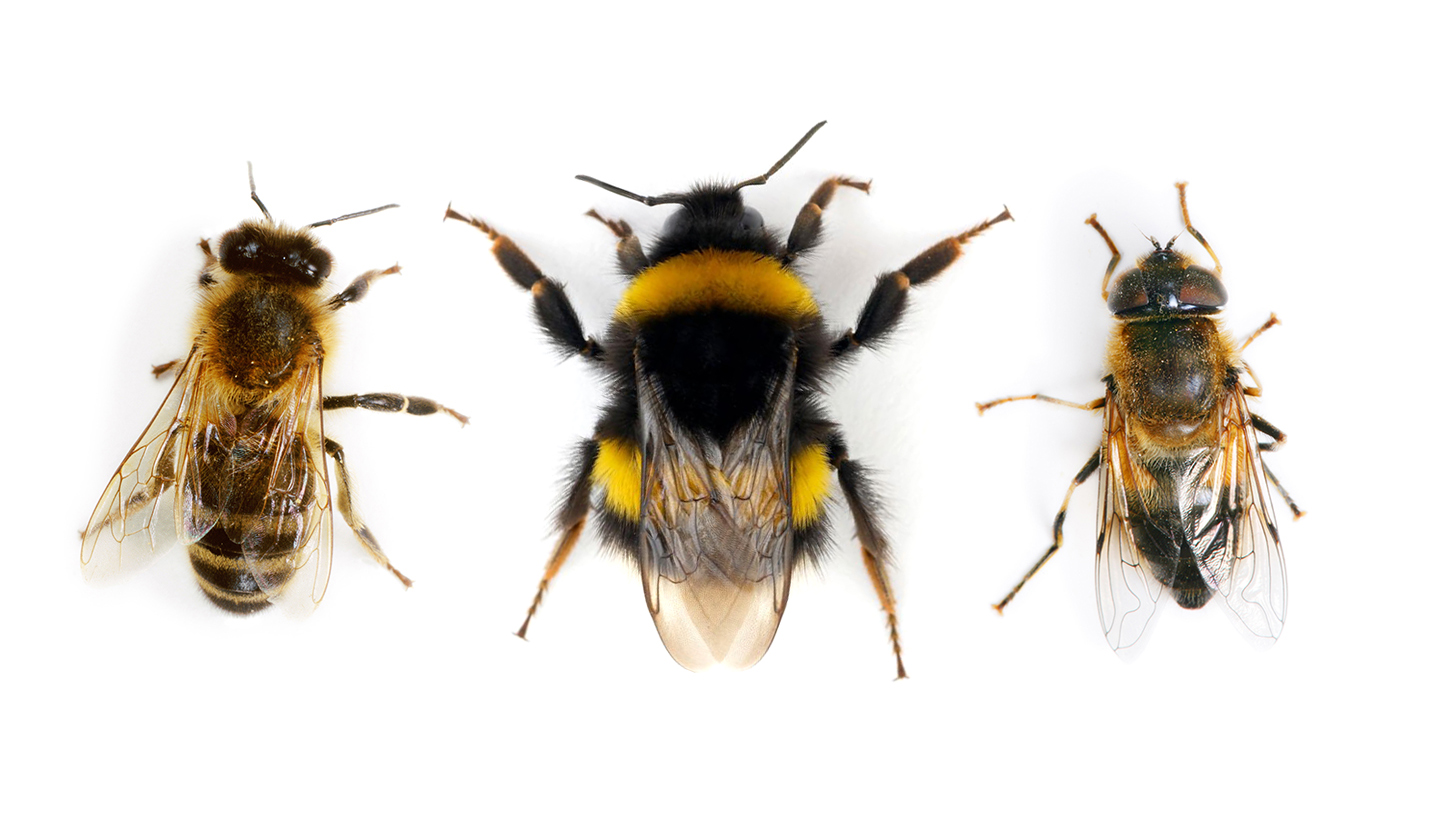
However, by the end of the 20th century, the development of intensive horticulture and greenhouse crops revealed the limitations of honey bees in protected environments. It was then, from 1987 onwards, that bumblebees of the genus Bombus terrestris began to be introduced commercially in Europe. Although the concept of bumblebees as natural pollinators was already known, their widespread use in protected crops as “managed” pollinators became established in the late 1980s and early 1990s, thanks to their “domestication” and the industrialization of their breeding process. In this way, they progressively replaced highly labor-intensive traditional methods such as manual pollination.
Nevertheless, earlier precedents do exist. As early as the 19th century, bumblebee species were introduced in places such as New Zealand for the pollination of red clover. However, these trials were part of acclimatization programs and were not directly equivalent to the modern commercialization of bumblebees for horticulture.
Over time, bumblebees became established as the most effective solution for agricultural pollination of crops such as greenhouse tomatoes in Europe. This effectiveness is explained by their ability to perform buzz pollination. As a consequence, within a few decades their use spread globally, although in some countries it is restricted or even prohibited due to environmental regulations. Since then, they have become a technical standard in agricultural pollination for more than four decades. The study by Velthuis and van Doorn (2005), published more than 20 years ago, reviews the history of bumblebees and their role in modern agriculture.
History of pollination with hoverflies
In parallel, during the second half of the 20th century, the first uses of dipterans of the family Syrphidae (hoverflies) as agents of agricultural pollination began to be scientifically documented. In particular, from the 1970s onwards, several pioneering studies carried out in Japan marked a starting point. Among them, the works of Kobayashi (1974) and later Ohsawa and Namai (1988) stand out. These studies demonstrated the potential of species such as Eristalis cerealis and Eristalis tenax in horticultural and oilseed crops, especially in protected systems.
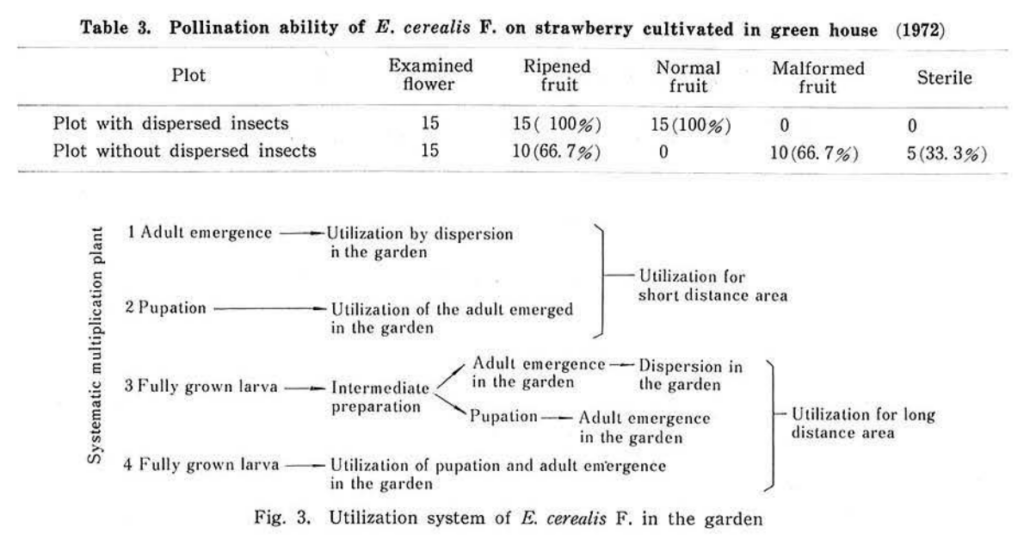
In addition, these studies laid the foundations for the development of artificial rearing methods and the controlled use of hoverflies, highlighting their tolerance to temperature variations, their constant activity, and their positive impact on fruit and seed production.
Throughout the 1980s and 1990s, this line of research spread to other countries. In particular, relevant studies were carried out in Germany (1994), South Korea, and Spain. These investigations focused on the mass rearing of hoverfly species from the subfamily Eristalinae, the optimization of their management, and their application in greenhouse crops. However, during this period hoverflies were used mainly in experimental and academic contexts. The absence of an industrial model limited their large-scale production, despite their proven pollination capacity.
Yet, already in the 21st century, large-scale research projects carried out in New Zealand (2019) and Australia (2025) aimed to study the potential of pollinating hoverflies for the pollination of commercial crops, both in protected environments and in open fields. And now, the agricultural sector faces a new historical milestone in pollination with the work of Polyfly. This is an initiative born in Almería that expands the traditional model by incorporating two new species of managed dipteran pollinators: Queenfly and Goldfly.
The world’s first hoverfly production facility
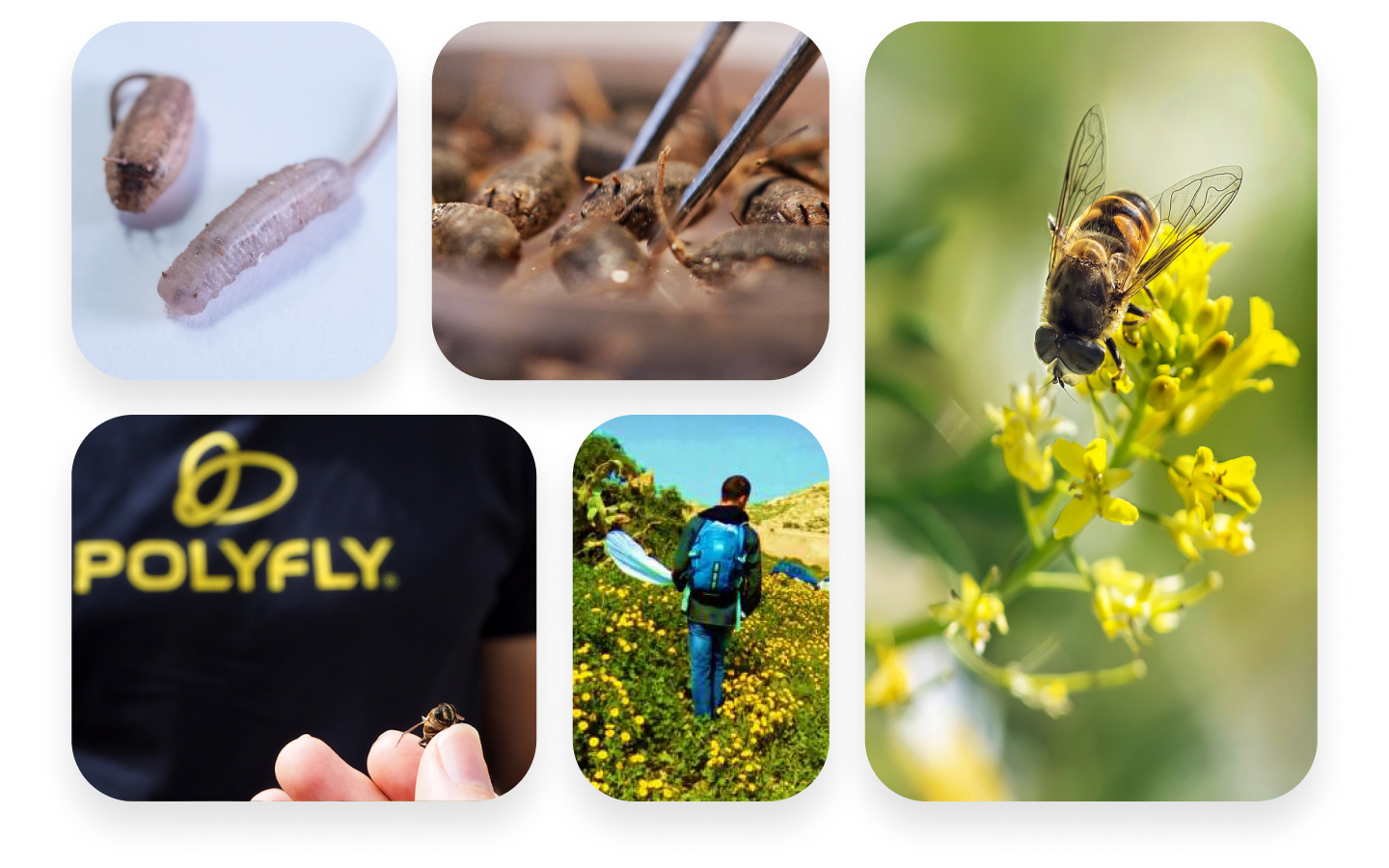
The true turning point lies in the fact that Polyfly has become the first company worldwide to achieve the industrialization and productive management of eristaline hoverflies on a large scale. This breakthrough is the result of a long trajectory of innovation based on scientific knowledge and technological development. As a result of this process, an industrial facility capable of continuously and controllably producing millions of hoverflies on a massive scale has been designed. In this way, their availability, traceability, and reliability for agricultural use on a global scale are ensured.
This is precisely the mission driven by its founders, Marc Vaez-Olivera and Yelitza Velásquez: to transform decades of scientific research into a real, scalable, and sustainable solution for the agricultural pollination of the future.
A natural pollination solution that represents a logical evolution of the sector. These are pollinators with differentiated behaviors and specific life cycles. Moreover, their applications are adapted to the demands of modern agriculture, both outdoors and in protected environments. Far from being conceived as an immediate replacement for bumblebees and bees, Polyfly enables the implementation of more diversified and efficient pollination systems. These systems are tailored to each crop, both for seed production and for the production of economically important horticultural crops.
In short, after centuries of dependence on bees and more than four decades with the incorporation of bumblebees, agricultural pollination is entering a new stage. In this phase, biological innovation and technical knowledge are decisive. With the incorporation of Queenfly and Goldfly, it is confirmed that the future of agriculture lies in understanding pollination as a living and constantly evolving ecosystem, whose sustainability and productivity also depend on diversification through efficient and competitive solutions.