New paper: Managed hoverflies as efficient pollinators for agriculture


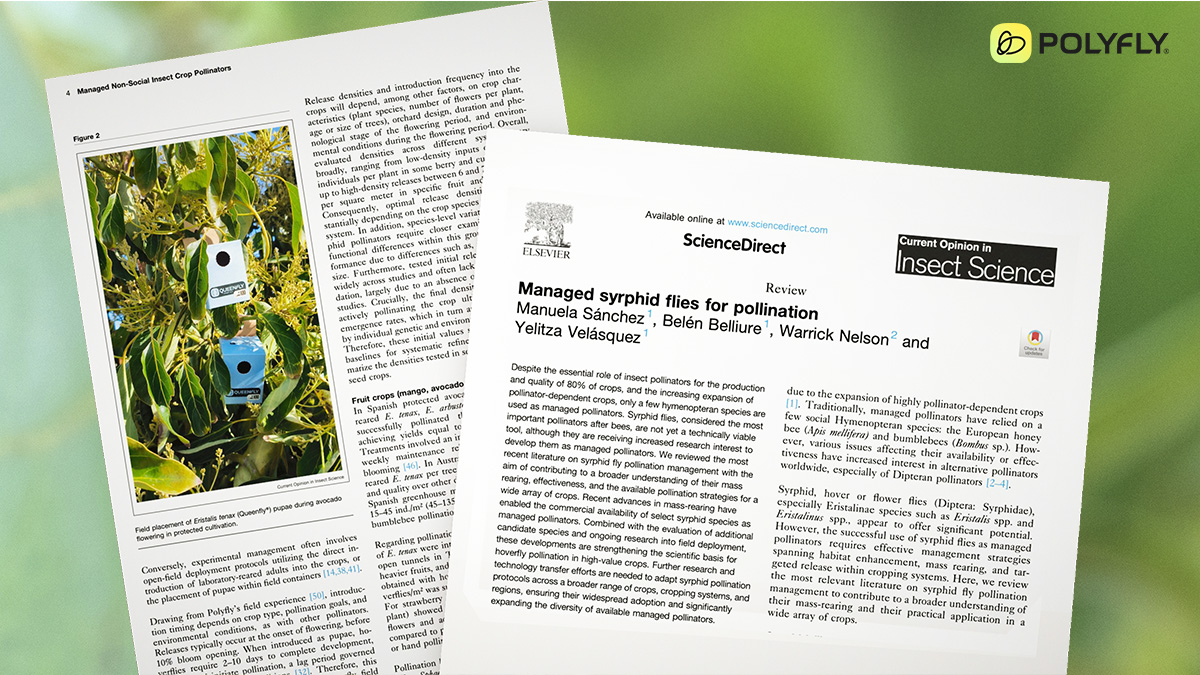
At Polyfly, we are pleased to announce a new scientific publication, “Managed hoverflies for pollination”, in the prestigious journal Current Opinion in Insect Science. This work, led by our research team, Manuela Sánchez, Belén Belliure and our founder Yelitza Velásquez, together with researcher Warrick Nelson, consolidates the role of hoverflies as the future of commercial pollination.
Insect pollination significantly improves the yield and quality of 74–80% of the world’s crops. However, modern agriculture has historically relied on a very small number of hymenopteran species (honeybees and bumblebees). Given climate challenges and the limitations of these traditional pollinators in enclosed environments, the search for effective alternatives is more critical than ever. Our article details how hoverflies, considered the second most important natural pollinators, are making the leap from nature to commercial agriculture.
- Highly effective alternatives: Hoverflies (especially the subfamily Eristalinae, such as QUUENFLY® and GOLDFLY®) are exceptional pollinators, capable of depositing large amounts of pollen and working efficiently under adverse weather conditions or in greenhouses.
- Biosecure rearing: Historically, the continuous rearing of Eristalinae posed major hygiene challenges due to its dependence on unstable organic matter. Today we have overcome this, ensuring clean and safe production at a commercial scale.
- A double benefit for growers: While Eristalinae stand out for their high pollination efficiency in high-value crops, other hoverfly species (Syrphinae) act as voracious aphid predators during their larval stage, making them perfect allies for Integrated Pest and Pollinator Management (IPPM). They are also an excellent complement or alternative to traditional bees in confined environments or under adverse weather conditions.
- The future of pollination: Commercial success lies in harnessing the specialization of each species. While Syrphinae are reared mainly for biological control, Eristalinae are establishing themselves as dedicated, highly efficient pollinators, each dominating its own agricultural niche.
The technological development we are driving at Polyfly is strengthening the scientific foundation to make hoverfly pollination an accessible, safe and highly profitable tool for growers around the world.
In this work, we review the management of pollination by hoverflies to contribute to a broader understanding of their mass rearing and their practical application across a wide range of crops.